Simplex Relaxation for Discrete Diffusion

1NTU Singapore, 2Purdue University, 3The University of Tokyo, 4IAIC, A*STAR, 5CFAR, A*STAR

TL;DR

Simplax enriches uniform discrete diffusion with an exact simplex-valued auxiliary state, enabling Rao–Blackwellized reverse-bridge training and sampling while preserving categorical corruption and token-based denoising.

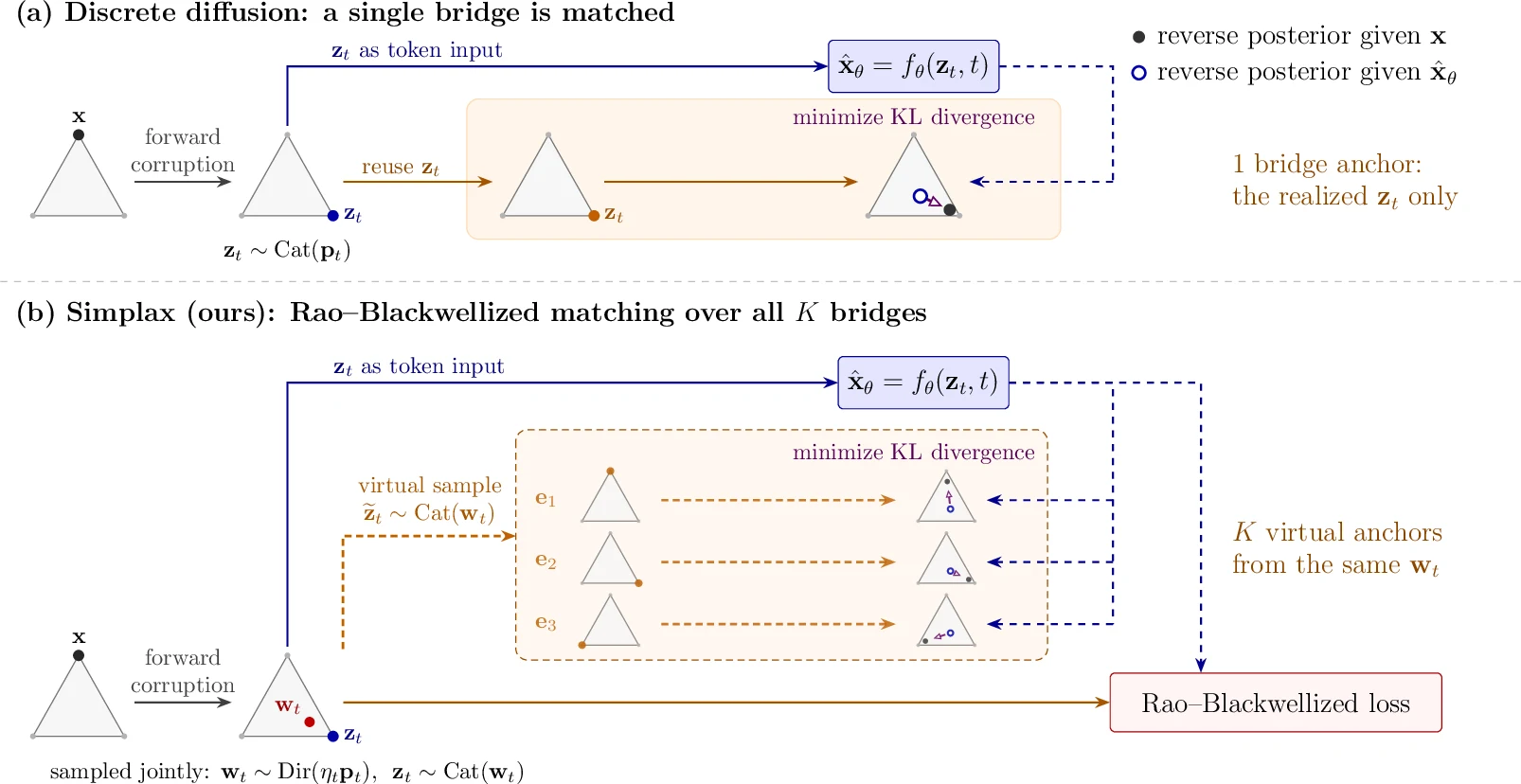
Standard discrete diffusion matches one bridge, while Simplax matches all K virtual bridges through a simplex state.
Standard discrete diffusion matches one realized bridge. Simplax marginalizes matching over all K virtual bridge anchors from the same simplex state.

Abstract

Discrete diffusion models for categorical generation are defined by a corruption kernel, which determines the intermediate state space and the associated reverse prediction problem. We study whether uniform discrete diffusion can be augmented with an explicit continuous state while leaving its categorical corruption process unchanged.

We introduce Simplax, an exact Dirichlet–categorical augmentation that couples each corrupted categorical state with an auxiliary simplex-valued variable while preserving uniform diffusion as its categorical marginal. This yields a tractable Rao–Blackwellized reverse-bridge objective and a stochastic reverse sampler, while retaining the corrupted categorical state as the denoiser input.

Simplax improves the generative perplexity–entropy tradeoff on unconditional OpenWebText generation. On Sudoku, a model trained exclusively on 30-clue puzzles achieves the highest accuracy among the compared methods across all evaluated clue densities, including the minimum uniquely solvable 17-clue regime, and the highest validity in unconditional generation.
Simplex Relaxation

Simplax couples a corrupted token zt to an auxiliary simplex state wt through a shifted Dirichlet conditional. Marginalizing wt exactly recovers the original uniform categorical process, and decoding from the simplex is ordinary categorical sampling.

During training, the denoiser still receives the sampled token. The auxiliary simplex state defines a distribution over all categorical bridge anchors, whose reverse-bridge losses can be marginalized analytically. The same hierarchy gives a reverse sampler that carries simplex information between steps without requiring dense simplex vectors as network inputs.

OpenWebText Generation

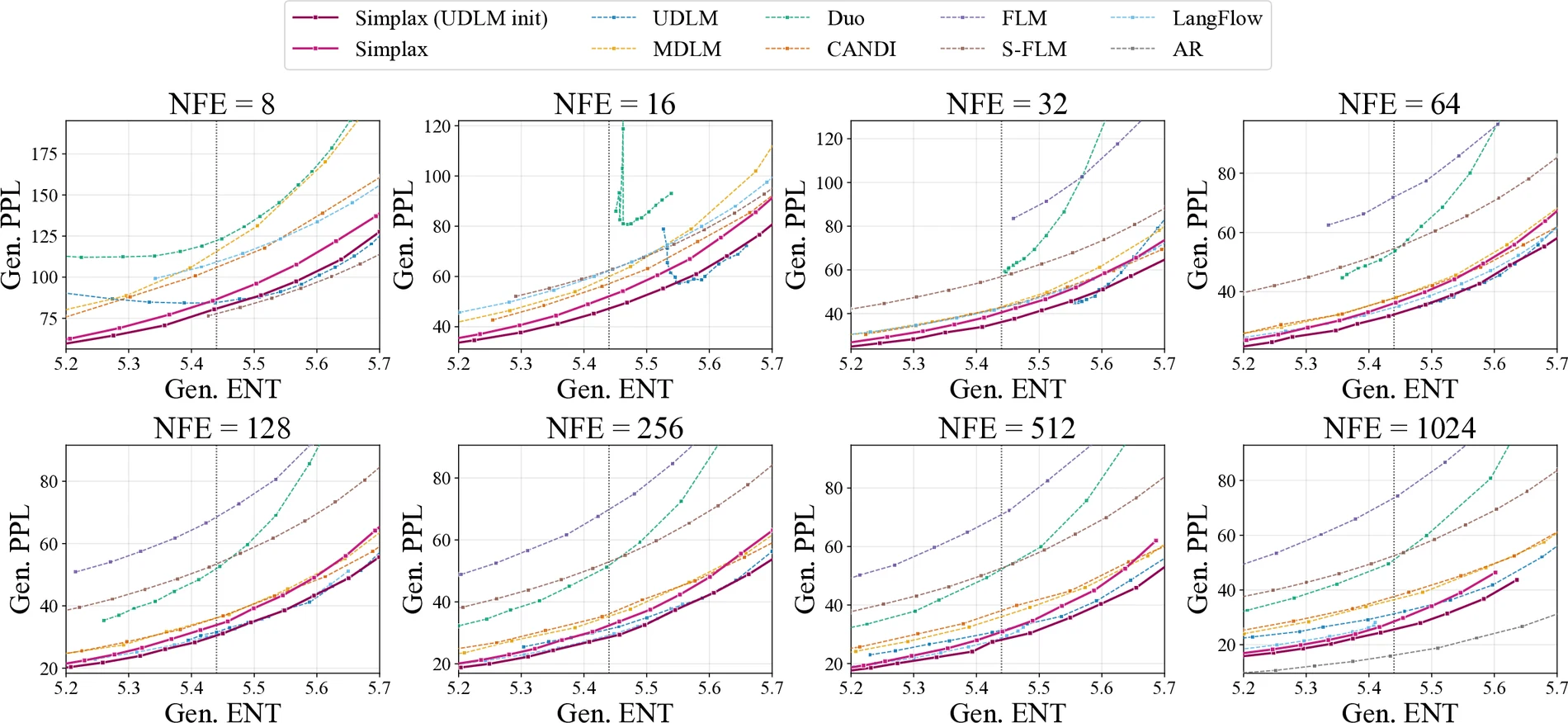
Simplax lies on or near the lower generative perplexity–entropy envelope across inference budgets. With UDLM initialization, it achieves the strongest matched-entropy perplexity among the compared diffusion methods at low and high NFE under both reported evaluators.

Generated Text Samples

Representative unconditional generations selected at the temperature whose unigram entropy is closest to the OpenWebText entropy of 5.44. Text is shown without manual rewriting and truncated at […].

Sudoku Generation

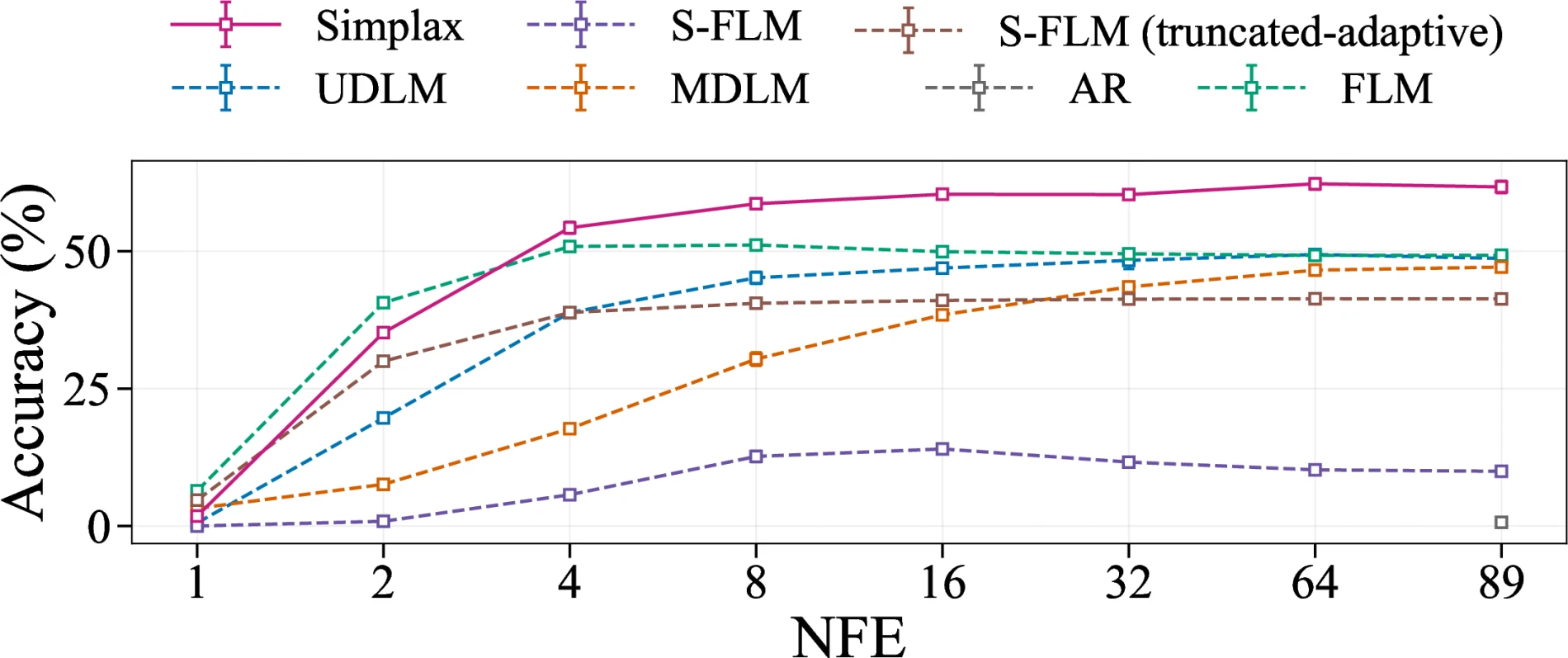
All models are trained only on 30-clue puzzles. Simplax obtains the highest conditional accuracy at every tested clue density and reaches 95.30% validity in unconditional generation.
NFE–Accuracy Comparison

All models are trained on 30-clue puzzles. Across inference-time clue counts, Simplax maintains strong performance even at low NFE.

Qualitative Samples

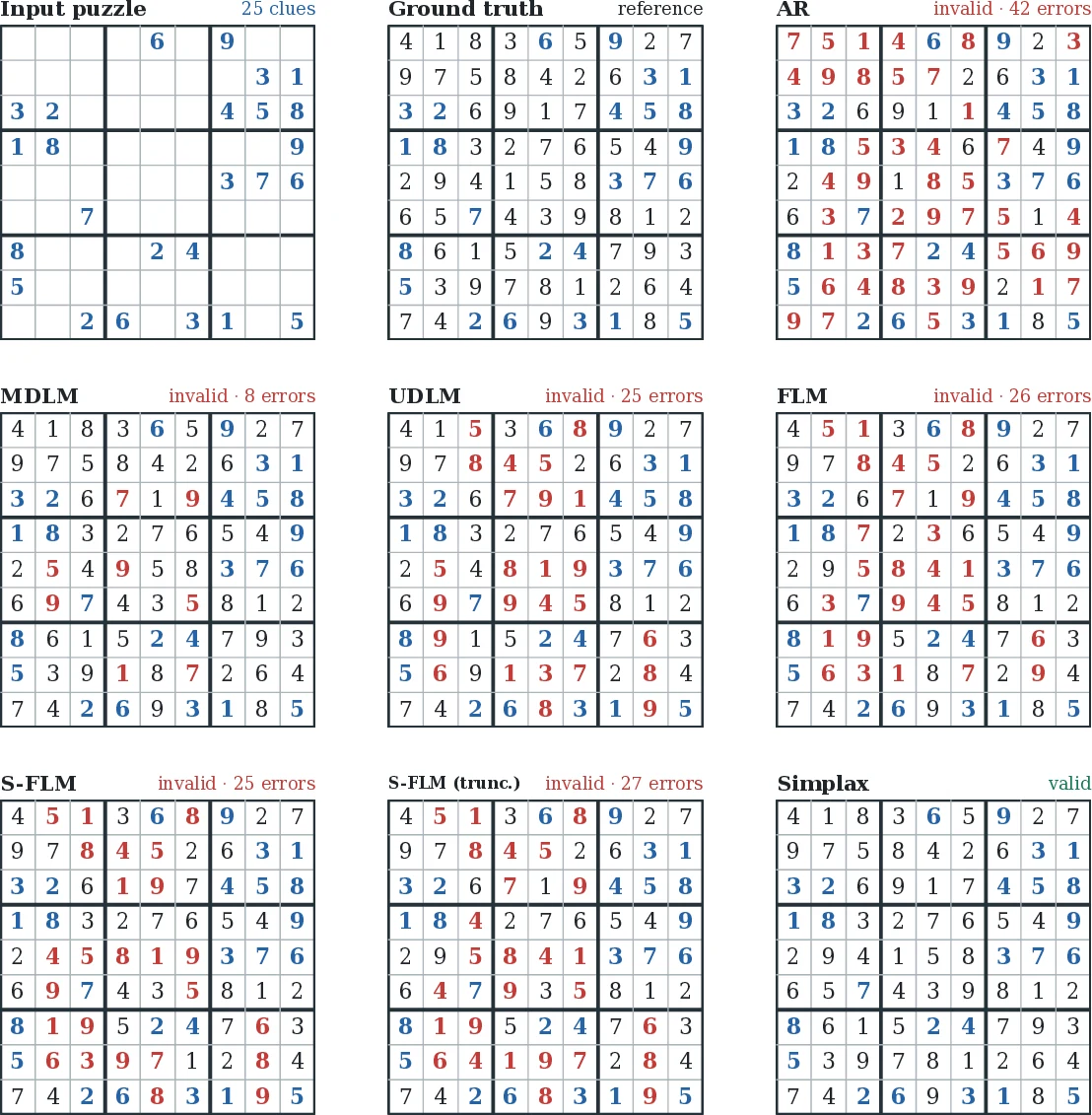
Sudoku generations from baseline models and Simplax for the same 25-clue puzzle; only Simplax is valid.
A representative 25-clue puzzle. Blue entries are given clues, black entries match the solution, and red entries are errors. Simplax produces the valid solution.

BibTeX

@misc{sakurai2026simplex,
  title         = {Simplex Relaxation for Discrete Diffusion},
  author        = {Jinya Sakurai and Patrick Pynadath and Satoshi Hayakawa
                   and Jaehong Yoon and Xulei Yang and Nancy F. Chen and Xun Xu},
  year          = {2026},
  eprint        = {2608.10615},
  archivePrefix = {arXiv},
  primaryClass  = {cs.CL}
}